
Featuring this article: https://priyankavergadia.substack.com/p/mcp-vs-api-a-developers-guide-to
💡 𝑺𝒕𝒖𝒅𝒚𝒊𝒏𝒈 𝒇𝒐𝒓 𝒄𝒍𝒐𝒖𝒅 𝒐𝒓 𝑨𝑰/𝑴𝑳 𝒄𝒆𝒓𝒕𝒊𝒇𝒊𝒄𝒂𝒕𝒊𝒐𝒏𝒔?
These eBooks were made by developers — for developers. No fluff. Just real questions.
📘 Try one: https://cloudcertificationstore.com/collection/all
⚡ 𝑹𝒆𝒂𝒅. 𝑷𝒓𝒂𝒄𝒕𝒊𝒄𝒆. 𝑷𝒂𝒔𝒔.
Why LLMs need the Model Context Protocol to replace hardcoded glue code.
Feb 19, 2026
We’ve spent the last twenty years mastering the API. It is the plumbing of the internet. If you’ve been in the game long enough, you probably dream in JSON schemas. You know the drill: read the docs, find the endpoint, wrestle with authentication headers, and write a strict, non-negotiable contract between your code and a service.
It’s deterministic. It’s reliable. If you send POST /payments with the right payload, you get a 200 OK. If you mess up a field name, you get a 400 error.
But recently, building AI powered apps has changed that equation. I was building an AI agent meant to troubleshoot server logs, and I realized that trying to hardcode standard API integrations into an LLM is a maintenance nightmare. I was writing boilerplate custom “glue code” just to translate what the model wanted to do into a structure the API accepted. I am sure you have been there!
That’s where the Model Context Protocol (MCP) came from. The difference isn’t really about the technology itself; it’s about who the consumer is.
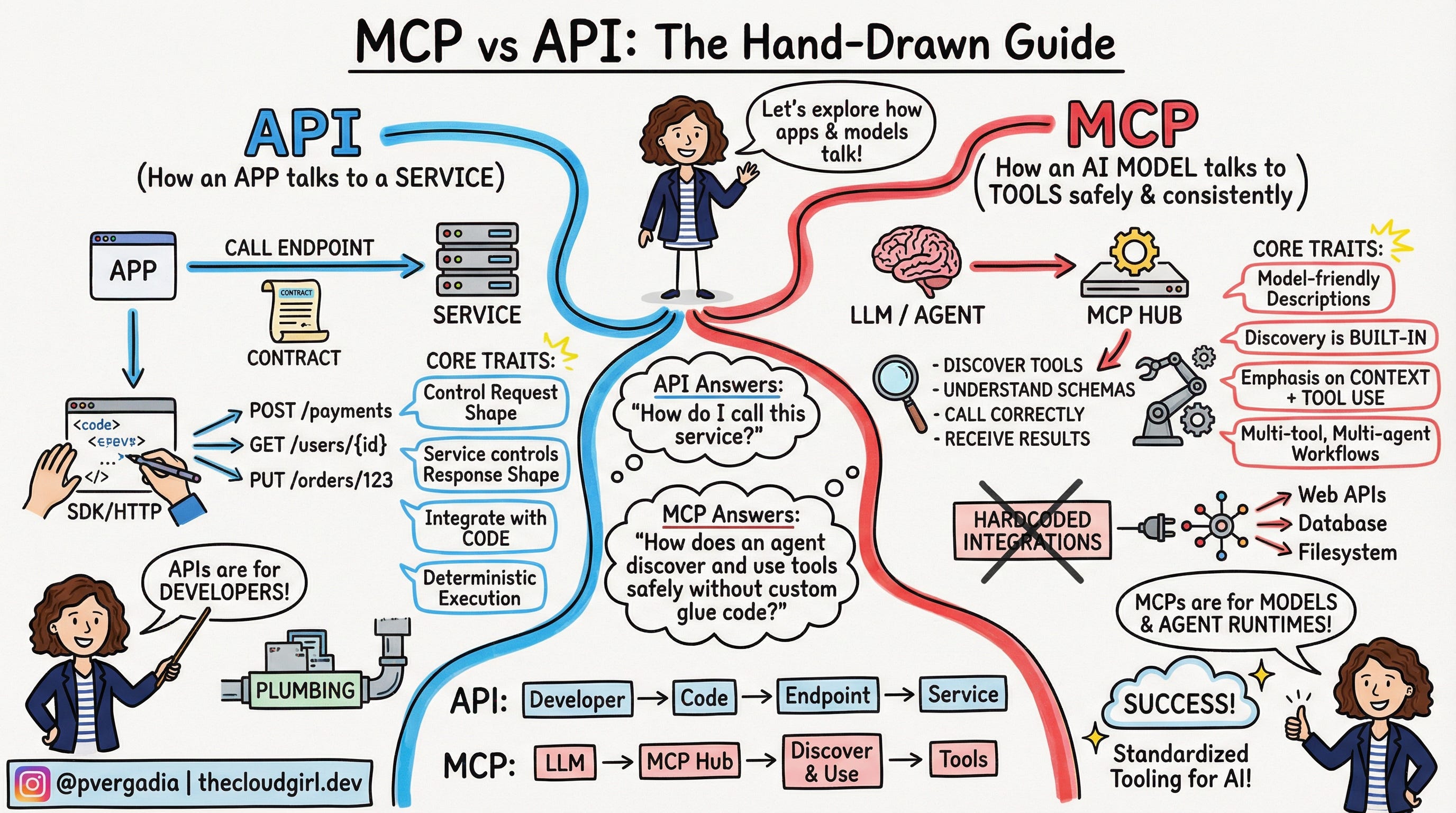
The API: Built for You (The Developer)
When you use a standard API, you are the intelligence. The API is dumb; it’s just waiting for instructions.
Think of an API like a command-line interface. It has a specific syntax. It doesn’t care about your intent; it only cares about your input. You have to read the manual, understand that /users/{id} requires an integer, and handle the error if the user is missing. The API answers the question: “How do I call this service?”
This works perfectly when you are building a traditional app with a hardcoded path: User clicks button → App fetches data → App displays data. You control the rails.
The MCP: Built for the Model (LLM)
MCP flips the script. The consumer here isn’t a human developer reading docs—it’s an AI agent or runtime.
An LLM doesn’t want to memorize thousands of specific API endpoints. It’s inefficient to stuff your system prompt with curl command examples. Instead, the model wants to know capabilities. MCP answers the question: “How does an agent discover and use tools safely?”
If an API is a command line, MCP is a universal adapter—like USB for AI.
Here is the “aha” moment I had: With MCP, you don’t write code that says, “Call endpoint X.” Instead, you spin up an MCP server that exposes resources (like logs) and tools (like “restart_service”). You connect the agent to this server, and the agent asks, “What tools do I have?”
The MCP server replies, “You can read logs or restart services. Here are the schemas for those actions.” The model then dynamically decides which tool to pull from its belt based on the conversation context.
Why the Distinction Matters
The shift from API to MCP is the shift from hardcoded execution to context-aware discovery.
If you have spent hours maintaining OpenAI function definitions. Every time an underlying API changed, you had to update the JSON schema in the prompt and update the TypeScript handler that executed it. It’s brittle.
With MCP, that friction disappears. You expose the tool once via the protocol. The agent discovers it. If you add a new tool to the MCP server, the agent “sees” it immediately without you rewriting the client-side logic.
To put it simply:
- API: You are the mapmaker. You draw the path, and the code follows it exactly.
- MCP: You give the Agent a compass and a map. You tell it the destination, and it figures out the path.
APIs aren’t going anywhere—they are still the foundational layer executing the work. But MCP is rapidly becoming the standard translation layer that lets us stop writing glue code and start building actual intelligence.